Sleep Health
Published August 12, 2026
7 minHow often should you replace a mattress
Most mattresses fall somewhere between 7 and 10 years, but the real answer depends on what yours is made of and how it's holding up.

Table of contents
How mattress lifespan varies by typeSigns your mattress is ready to be replacedHow to extend your mattress's lifeWhen replacement makes more sense than waitingIs now the right time?Frequently asked questions
The general rule of thumb is to replace your mattress every seven to ten years, but a more useful answer lives one layer deeper. Lifespan varies meaningfully by construction type, and the clearest signal that your mattress is done isn't the date on the receipt — it's what you're waking up with.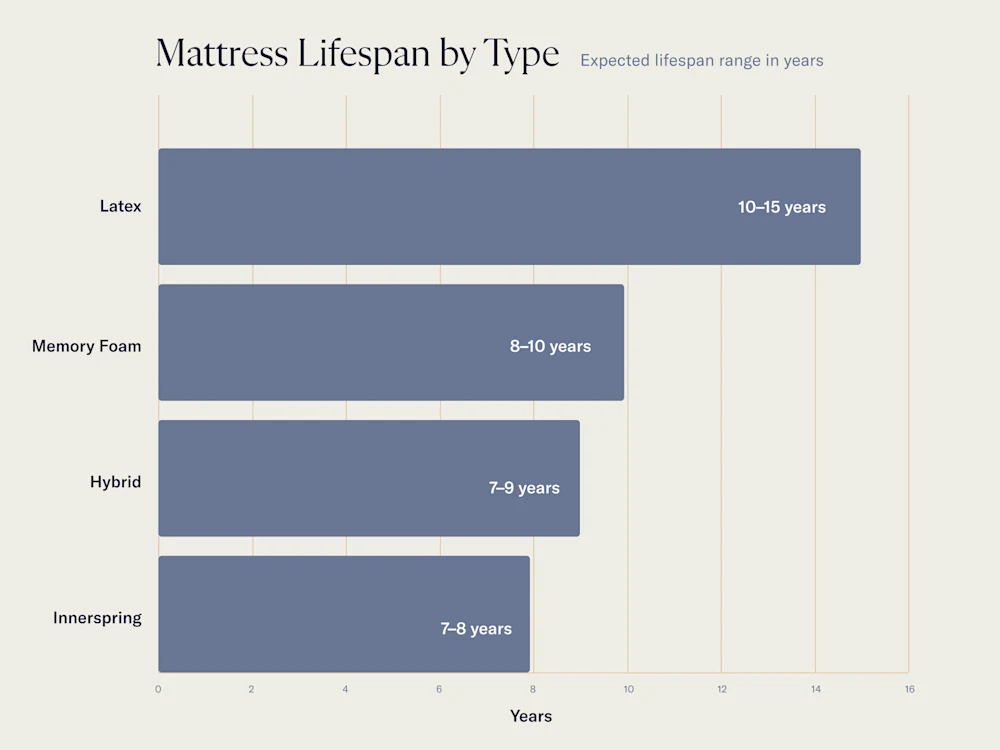
How mattress lifespan varies by type
Not all mattresses age at the same rate. The materials and construction underneath you have as much to do with longevity as how often you sleep on it.Memory foam mattresses typically hold up for eight to ten years with regular use. They're resilient under consistent pressure but can develop body impressions over time, particularly if the foam density is on the lower end. Higher-density foam holds its shape longer and tends to maintain its support structure well into the back half of that range.Innerspring and hybrid mattresses generally land in the seven-to-nine-year range. The coil system adds responsive support that foam alone can't replicate, but coils can weaken at high-use contact points over time — especially in lower coil-count models. Hybrids, which pair coil support with comfort foam layers, often hold up well because the foam absorbs impact before the coils take the full load.Latex is the outlier for longevity. Natural latex mattresses often last ten to fifteen years because the material is inherently resilient and resistant to compression set. It tends to recover its shape better than foam alternatives and doesn't develop the same kind of body impressions over time.Pillow tops and euro tops are worth separating from the underlying mattress. The added comfort layer gives a softer feel out of the box, but it's typically the first thing to compress and flatten. The mattress beneath may have years left; the top layer will feel noticeably different well before that.Signs your mattress is ready to be replaced
Calendar math will only get you so far. Some mattresses wear faster depending on body weight, whether you use a mattress protector, how consistently you rotate, and whether children or pets share the surface. These are the signals worth tracking regardless of age.Visible sagging or body impressions. A dip of more than an inch in the area where you sleep is a reliable indicator that the support structure has shifted. When a mattress has settled into the shape of you rather than adjusting to you, your spine is no longer getting the alignment it needs.Morning stiffness or aching that clears during the day. If your back, hips, or shoulders feel better after you've been up and moving for an hour, your sleep surface is worth examining. Persistent discomfort that resolves with movement often points to inadequate support rather than anything unrelated to your mattress.Sleep quality that has quietly declined. This one can be easy to miss because it tends to be gradual. If you're waking more often, taking longer to fall asleep, or feeling less rested without an obvious explanation, your mattress may be contributing more than you realize.Increased sensitivity to a partner's movement. A mattress that once handled motion well but now transfers every shift and turn has likely lost some of the structural integrity that made that isolation possible.Allergy symptoms that spike overnight. Over time, mattresses accumulate dust mites and allergens, and even with regular cleaning and a protector, older foam can harbor more than a newer surface would. If you're waking with congestion or irritation that's consistently worse in the morning, age is worth factoring into the equation.How to extend your mattress's life
Getting the full lifespan out of a mattress has more to do with consistent routine than anything dramatic.A mattress protector is the single most effective step — it prevents moisture, skin cells, and debris from working into the foam layers, where they accelerate breakdown. Rotating head to foot every three to six months distributes wear more evenly across the surface, since most sleepers concentrate pressure in the same areas night after night. A proper base matters too: slatted frames with gaps wider than three inches can allow sections of the mattress to sag where they lack support underneath.Our mattresses are built with these realities in mind. DreamCloud’s individually wrapped coil system and CloudQuilt™ cover are designed to hold their performance across years of regular use, not just the first months on a new surface.Not sure which mattress fits you best? Find out now.
When replacement makes more sense than waiting
The harder question isn't usually "is my mattress old?" — it's "is this the reason I'm sleeping the way I'm sleeping?"If you've had the same mattress for eight or more years and your sleep has shifted in a way you can't otherwise account for, replacement is worth taking seriously rather than treating as a last resort. Sleep compounds in both directions: the better it is, the better everything around it tends to be.If you're not sure whether your current mattress is still doing its job, a 365-night trial takes a lot of that uncertainty off the table. Our Mattress Trial Period Guide walks through how to use that window well — and what to pay attention to in the first 30 nights before drawing any conclusions.Is now the right time?
Run through these with your own sleep in mind:- Your mattress is eight years old or more
- You're waking with stiffness that fades after an hour or two of being up
- You sleep noticeably better on other surfaces — hotel beds, guest rooms
- Visible sags or body impressions have developed in your usual sleeping area
- A partner's movement is waking you more than it used to
- Allergy symptoms are consistently worse in the morning