Sleep Health
Published February 13, 2026
9 minMemory Foam Mattress Guide 2026: Science-Backed Comfort Tips
Whether you sleep hot, deal with back pain, or share your bed with a partner, the right memory foam mattress comes down to a handful of factors worth understanding before you buy.
Table of contents
Why memory foam feels so comfortableKey definitionsWhat makes a memory foam mattress comfortableComfort by sleeping styleOur memory foam lineupWhich model fits your searchTwo at-home tests worth knowingWhat to consider when you shopFind the memory foam mattress built for how you sleepFrequently asked questions
Back pain, restless sleep, night sweats — a memory foam mattress can often address all three, but only if you pick the right one. Our lineup is built around the science of how foam interacts with your body: pressure, heat, and alignment. The best choice isn't the one with the most features. It's the one that matches your firmness preference, support needs, and temperature sensitivity. Here's what you need to know.
Side sleepers need contouring to relieve pressure at the shoulders and hips. Without adequate sinkage, they can experience numb arms or hip pain. Zoned memory foam or plush top layers are ideal.Back and stomach sleepers require firmer support to prevent sinkage and promote spinal alignment. Stomach sleepers especially need a surface that won't bow the lower back, so foam density should resist sagging.Couples benefit from strong motion isolation so neither partner feels the other moving. Reinforced edges maximize the usable sleep surface, and zoned support helps partners with different needs.Hot sleepers should look for cooling technologies built into the foam. Traditional memory foam can trap heat, but newer models use open-cell or gel-infused designs, PCM covers, and breathable fabrics to help regulate temperature.Back pain sufferers need a mattress that combines support and cushioning. Zoned lumbar support can help keep the spine aligned throughout the night, and medium-firm memory foam is often recommended for pain relief.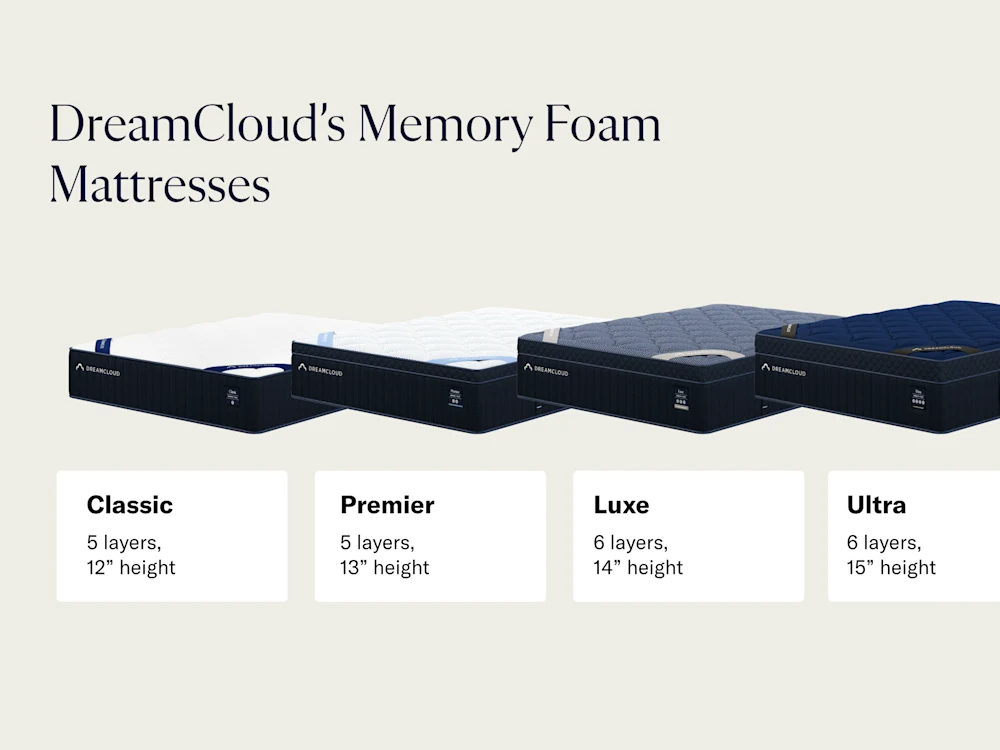
Why memory foam feels so comfortable
Memory foam stands out for two things: pressure relief and spinal alignment. Originally developed by NASA in the 1960s for aircraft seat cushioning, viscoelastic foam softens in response to body heat and pressure, contouring to your shape rather than pushing back uniformly. Studies show that pressure mapping on high-quality memory foam can reduce tension at pressure points compared to traditional innerspring mattresses, a real advantage for long-term comfort.What our memory foam mattresses provide:- Pressure relief: Cushions hips and shoulders, reducing soreness and improving circulation
- Spinal alignment: Keeps your spine neutral, easing back pain and reducing stiffness
- Motion isolation: Absorbs movement, ideal for couples who don't want to feel a partner tossing and turning
- Cooling features: Our models include gel infusions, phase-change materials (PCM), and breathable covers to prevent overheating
- Noise-free design: Memory foam is silent, with no springs that may squeak overnight
Key definitions
Before comparing models, these terms help cut through the marketing:Pressure relief: The foam contours to the shoulders and hips so you don't wake up sore or shifting positions through the night.Spinal alignment: The mattress prevents the hips from sinking too far (hammocking) and supports the lower back in a neutral position.Zoned support: The foam is engineered to support different body areas differently, typically providing more support under the hips and lumbar region and more give at the shoulders.Phase change material (PCM): A cooling technology embedded in the mattress cover that absorbs and releases heat to help regulate surface temperature.What makes a memory foam mattress comfortable
Not all memory foam mattresses are created equal. The most comfortable ones share specific design features that improve not just how the mattress feels, but how it performs over time.Look for:- Zoned support: Firmer foam under the hips and softer foam under the shoulders to promote ergonomic alignment
- Responsive layers: Helps combination sleepers switch positions with ease
- High-density foam: Generally 4 to 5 pounds per cubic foot for durability and long-term comfort
- Breathable covers: Fabrics like Tencel or phase-change materials help regulate temperature
- Gel-infused foam: Enhances airflow and draws heat away from the body
Comfort by sleeping style
Your ideal memory foam mattress depends largely on how you sleep. Comfort isn't one-size-fits-all.| Sleep profile | Recommended firmness | Key features needed | Cooling needed? |
| Side sleepers | Soft–medium | Contouring, pressure relief, plush top layers | Maybe |
| Back/stomach sleepers | Medium–firm | Supportive base, lumbar alignment | Optional |
| Couples | Medium | Motion isolation, strong edge support | Yes |
| Hot sleepers | Medium | Gel-infused foam, breathable cover, PCM fabric | Definitely |
| Back pain sufferers | Medium–firm | Zoned support, responsive layers, spinal alignment | Yes |
Our memory foam lineup
All DreamCloud memory foam models include a 365-Night Home Trial and a Forever Warranty™.DreamCloud Classic Memory FoamFeel: Extra-firm | Height: 12" | Layers: 5The firmest all-foam model in our lineup. Features a CloudQuilt™ top with cooling fibers and a contouring memory foam layer. Best for sleepers who want a firm, stable feel with minimal sink, typically back sleepers, stomach sleepers, or anyone who dislikes a hugging feel.DreamCloud Premier Memory FoamFeel: Firm | Height: 13" | Layers: 5Our most popular memory foam mattress. Built with 2x the cooling fibers and 2x the memory foam of the Classic. Best for sleepers who want firm support with slightly more cushioning, a reliable middle-ground option.DreamCloud Luxe Memory FoamFeel: Medium-firm | Height: 14" | Layers: 6The first model in our lineup to include tri-zone (three-zone) support targeted to the back and hips for alignment, plus phase change material (PCM) and cooling fibers in the cover. Best for back pain sleepers whose discomfort is tied to alignment, particularly at the lumbar region and hips.DreamCloud Ultra Memory FoamFeel: Medium | Height: 15" | Layers: 6The most elevated model in our lineup. Features five-zone targeted support across the shoulders, back, hips, and legs for personalized alignment, plus PCM and cooling fibers. Built with 4x the cooling and memory foam support of the Classic. Best for sleepers who want a plusher surface feel while still maintaining zoned alignment support.Not sure which mattress fits you best? Find out now.
Which model fits your search
"Memory foam mattress for back pain"Back pain is primarily an alignment problem, with pressure relief secondary. A simple way to choose:- For more structured support with less sink: Classic (extra-firm) or Premier (firm)
- For targeted alignment help at the hips and lumbar region: Luxe (tri-zone support) or Ultra (five-zone support)
Two at-home tests worth knowing
Before committing to any mattress, these quick tests can reveal fit issues:10-minute sink test: Lie in your normal sleep position for 10 minutes. If your hips keep sinking and your lower back starts to feel pulled or unsupported, you likely need more firmness, support, or zoning.Alignment photo test: Have someone take a side photo while you're lying in your normal sleep position. Look for a neutral spine line. A U-shape indicates hammocking. A visible gap at the lower back indicates a lumbar gap.What to consider when you shop
These tips apply whether you're comparing our models or evaluating any memory foam mattress:- Try before you commit: Opt for long sleep trials (100+ nights). Our 365-Night Trial lets you test comfort fully before deciding
- Compare materials: Look beyond "memory foam" and compare gel, breathable foam, and hybrid designs
- Check reviews: Look for consistent praise in expert tests and verified user feedback
- Prioritize durability: High-density foam and multi-layer construction last longer
- Consider the extras: Free shipping, returns, and white-glove delivery can make a meaningful difference in the purchase experience