Buying Guides
Published May 11, 2026
11 minMattress Sizes Explained: Complete Guide to Every Size
Finding the right size matters just as much as the feel — and the right answer is more straightforward than most people expect.

Table of contents
Mattress Sizes at a GlanceTwin: 38" × 75"Twin XL: 38" × 80"Full: 54" × 75"Queen: 60" × 80"King: 76" × 80"California King: 72" × 84"Split King: 76" × 80" (Two Twin XLs)How to Choose the Right SizeFrequently Asked Questions
Mattress size is one of those decisions that feels obvious until you're actually making it. Most people start with a gut sense, only to discover that their room is smaller than they remembered, that their bed needs to fit two adults and a dog, that a California King is an inch too long for the bed frame they already own. A little context on what each size actually is goes a long way before you commit.Here's everything you need to know about every standard mattress size.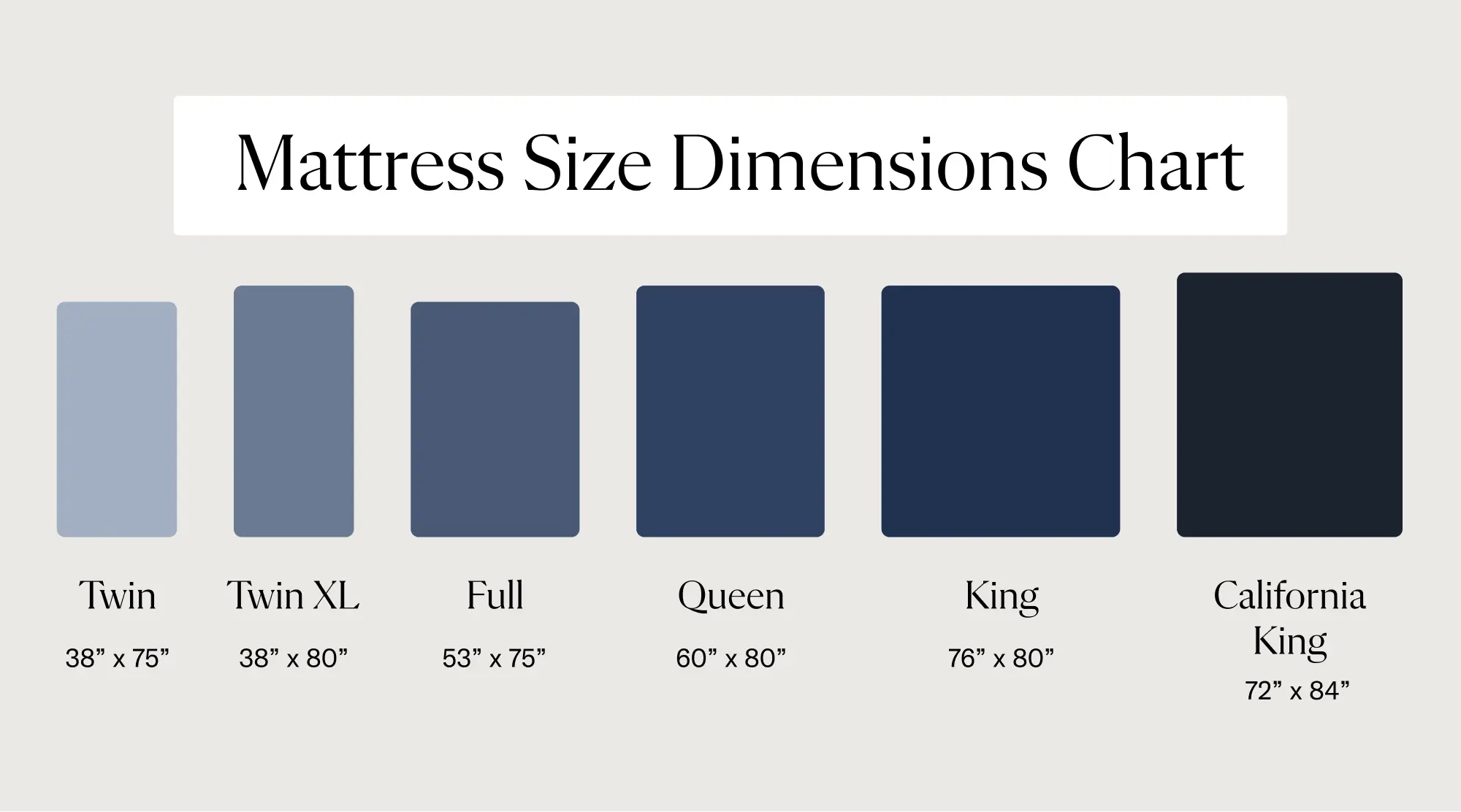
![https://res.cloudinary.com/dxeq6jwsb/image/upload/v1778532311/king-vs-queen-room-layout-size-guide.webp,[object Object],](https://res.cloudinary.com/dxeq6jwsb/image/upload/v1778532311/king-vs-queen-room-layout-size-guide.webp)
Mattress Sizes at a Glance
| Size | Dimensions | Best For |
| Twin | 38" × 75" | Kids, bunk beds, small rooms |
| Twin XL | 38" × 80" | Taller sleepers, college dorms |
| Full | 54" × 75" | Solo adults, guest rooms |
| Queen | 60" × 80" | Solo adults, couples |
| King | 76" × 80" | Couples who want maximum width |
| California King | 72" × 84" | Taller sleepers, couples in long rooms |
| Split King | 76" × 80" | Couples with different sleep preferences |
Twin: 38" × 75"
The Twin is the smallest standard mattress size and the most common choice for children's rooms and bunk beds. At 38 inches wide and 75 inches long, it fits comfortably in a smaller bedroom without overwhelming the space — and it's narrow enough to work with bunk and loft frame configurations that other sizes can't accommodate.The length is worth noting for taller sleepers: at 75 inches, a Twin runs about 6'3", which leaves little room for anyone approaching or exceeding that height. For a child who's still growing, it's worth thinking ahead — a Twin XL adds 5 inches of length and fits the same width, so it's an easy upgrade that buys a few more years.Minimum room size: 8' × 10', with enough clearance on three sides to move comfortably.Twin XL: 38" × 80"
The Twin XL matches the Twin's 38-inch width but stretches to 80 inches long — the same length as a Queen or King. It's the standard size for college dormitory beds, which is why it tends to sell in volume during back-to-school season, but it's genuinely useful beyond that context.For taller solo sleepers in smaller rooms, the Twin XL is often the practical answer: it provides full adult length without the width of a Full or Queen. Two Twin XLs placed side by side also make up the exact dimensions of a King, which is the foundation of a Split King setup for couples who want individual control over their side of the bed.Minimum room size: 8' × 10', same as a Twin — the added length doesn't change the footprint significantly.Full: 54" × 75"
The Full, sometimes called a Double, is 54 inches wide and 75 inches long, giving it 16 more inches of width than a Twin while keeping the same 75-inch length. That extra width makes it a comfortable solo adult bed, particularly in smaller apartments or guest rooms where a Queen would feel like too much.The Full's limitation is length: at 75 inches, it shares the same shortfall as a Twin for taller sleepers, and it's narrow enough that two adults sleeping together will feel the constraints — 54 inches is 27 inches per person, which is less than the width of a Twin. As a guest room bed for solo visitors, it's ideal. As a long-term solution for couples, a Queen is usually worth the additional footprint.Minimum room size: 10' × 10', with 2 feet of clearance on each side recommended for comfortable movement.Not sure which mattress fits you best? Find out now.
Queen: 60" × 80"
The Queen is the most popular mattress size in the United States, and the reasons aren't hard to see. At 60 inches wide and 80 inches long, it gives couples enough shared space to sleep comfortably without requiring a large bedroom — and it works just as well for solo sleepers who want room to stretch out.The 80-inch length is a meaningful upgrade over the Full and Twin, accommodating most adult heights comfortably. For couples, the 60-inch width breaks down to 30 inches per person, which is workable for most, though those who tend to spread out or share the bed with a pet may feel the limits over time. As a starting point for two adults, a Queen is the practical default.Minimum room size: 10' × 10', though 10' × 12' gives you more comfortable clearance on all sides.King: 76" × 80"
The King is the widest standard mattress size available, at 76 inches wide and 80 inches long. That extra 16 inches over a Queen, about 38 inches per person, makes it the most spacious option for couples, and the length holds the same 80-inch standard. For anyone who shares a bed with a partner who moves, or who co-sleeps with children or pets, the King's width is the most meaningful upgrade in the lineup.The trade-off is room size. A King needs a bedroom that can absorb it without feeling cramped — a 12' × 12' room is typically the minimum for comfortable clearance on three sides. Moving a King mattress through doorways and up staircases also requires a bit more planning than smaller sizes, though most modern mattresses ship compressed and boxed, which makes delivery considerably easier than it used to be.Minimum room size: 12' × 12', with 12' × 14' or larger being more comfortable.California King: 72" × 84"
The California King is 4 inches narrower than a standard King but 4 inches longer: 72 inches wide by 84 inches long. That makes it the longest standard mattress size available and the natural choice for very tall sleepers who find even a King's 80-inch length leaves their feet near the edge.The narrower width means couples give up some of the shared space that makes a King so comfortable – 36 inches per person versus 38. For most couples, that difference is minor, but it's worth noting. The California King also tends to work better in longer, narrower bedrooms where a standard King's width would leave too little clearance on the sides. Bedding and accessories are slightly less universally available in Cal King sizing, which is a minor but real consideration.Minimum room size: 12' × 12', ideally a room that's longer than it is wide.Split King: 76" × 80" (Two Twin XLs)
A Split King is two Twin XL mattresses placed side by side. Together, they match the standard King's 76" × 80" footprint exactly. The reason to choose a Split King over a standard King is adjustability: if you have an adjustable base, each side of the bed can easily move independently.For couples with genuinely different sleep preferences — one person who sleeps flat and one who sleeps with the head elevated, or two people at different ends of the firmness spectrum — a Split King effectively gives each sleeper their own mattress. The gap down the middle is a real consideration for couples who prefer to sleep close, and bedding requires some thought since standard King sheets sit across both sides, while some couples prefer individual sets.Minimum room size: Same as a King — 12' × 12' minimum.