Mattresses
Published June 18, 2026
7 minMattress Motion Isolation Explained
How one person can slip out of bed at 5 a.m. without the other ever stirring — and what makes some mattresses so much better at it than others.
Table of contents
What Motion Isolation Actually MeansWhy Motion Isolation Matters for CouplesHow Different Mattresses Handle MovementWhat Makes Our Hybrid So Quiet Under Two SleepersWhat to Look For When You're Comparing OptionsSo, How Much Should Motion Isolation Factor Into Your Decision?Frequently Asked Questions
You tend to learn the value of motion isolation the hard way, usually around the third time your partner's tossing and turning has pulled you out of the deepest part of your sleep. It's the quality that decides whether their movement becomes your problem, and it varies more from one mattress to the next than most people realize. Understanding how motion isolation works makes it far easier to tell which beds will actually keep the peace — and which ones only claim to.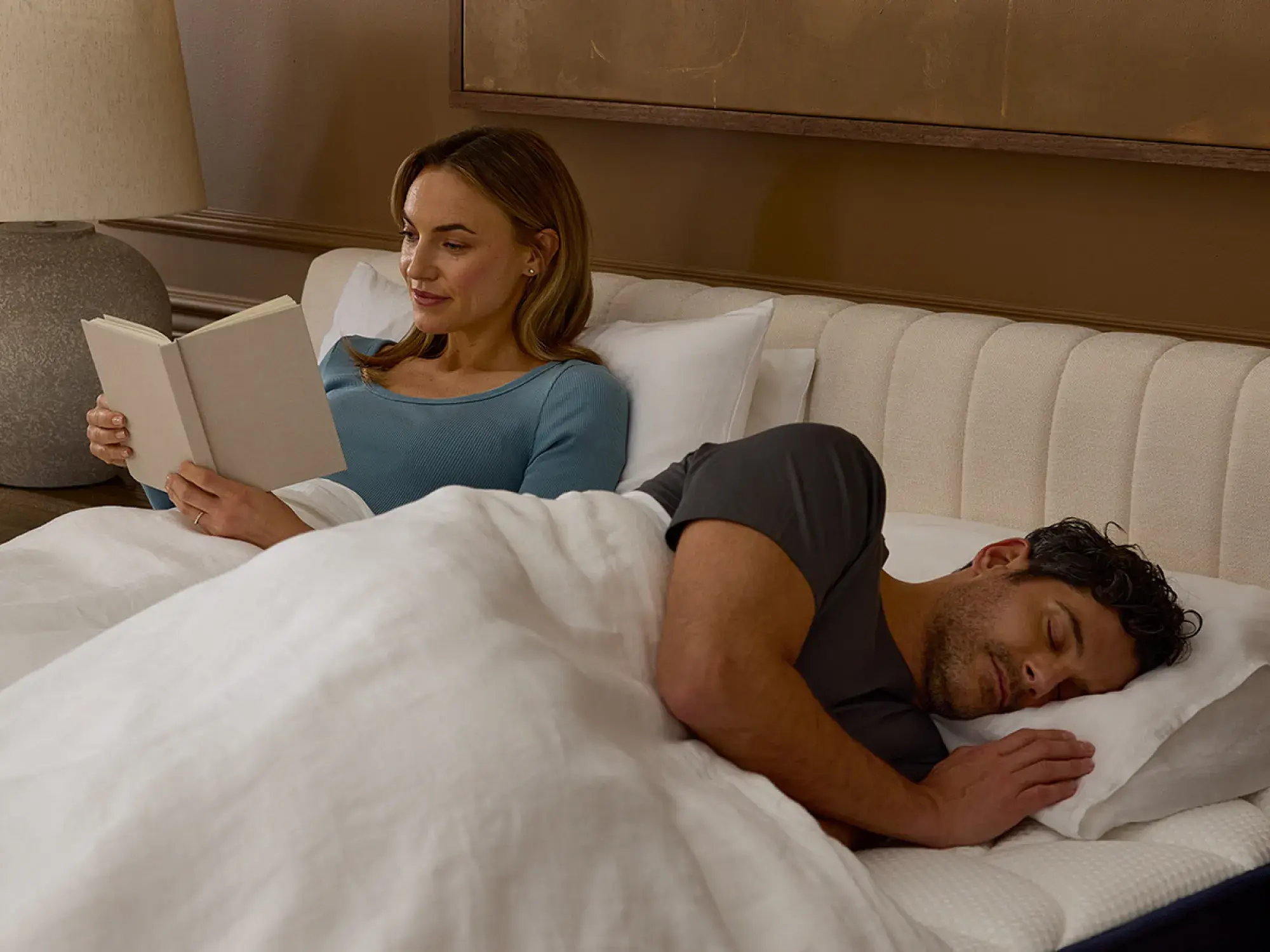

Not sure which mattress fits you best? Find out now.
What Motion Isolation Actually Means
Motion isolation describes how well a mattress absorbs movement in one area instead of carrying it across the surface to another. When someone shifts, rolls, or gets up, that movement creates energy, and a mattress either contains it where it happens or passes it around them. A bed with strong motion isolation keeps any disturbances close to their source, so a partner's restlessness stays on their side rather than rippling over to yours.The classic test is one you've likely seen in a commercial: a glass of wine resting on one side of the mattress while someone jumps up and down on the other. On a bed that isolates motion well, the glass barely trembles. On one that doesn't, it tips. Real sleep is messier than that demonstration, but the principle holds — the same construction that steadies a wine glass is what keeps a late-night shift from registering on the other side of the bed.Why Motion Isolation Matters for Couples
For anyone sleeping alone, motion isolation rarely registers as a concern, because there's no second source of movement to manage. The moment two people share a bed, though, it becomes one of the things that quietly shapes how rested you both feel. Different schedules, different sleep styles, and the simple reality of two bodies moving independently all add up over the course of a night.The cost of poor motion isolation is rarely one dramatic wake-up. It's the accumulation of small ones that surface briefly each time your partner turns over – never quite dropping back into deep sleep, waking oddly tired despite a full night in bed. Light sleepers feel this most acutely, as do couples whose hours don't align, where one person's early alarm or late arrival lands squarely in the middle of the other's rest.How Different Mattresses Handle Movement
A mattress's ability to isolate motion comes down almost entirely to what it's built from, and different materials behave in genuinely different ways.Memory foam has long been the benchmark for motion isolation because its slow, contouring response absorbs energy rather than transmitting it. Press a hand into memory foam and the surface yields right where the pressure lands, leaving the area beside it largely undisturbed — which is exactly why an all-foam bed tends to feel so still under a restless partner.Traditional innerspring mattresses sit at the opposite end. Their coils are connected to one another, so pressure on one set of springs travels through the whole network, broadcasting movement across the bed in a way that anyone who's shared an old spring mattress will recognize immediately.Hybrid mattresses bridge the two approaches, and this is where motion isolation gets interesting. Rather than a connected coil unit, a well-made hybrid uses individually wrapped coils — each one responding to pressure on its own, without pulling its neighbors along. Paired with comfort foams up top, the result is a bed that contains movement much the way foam does, while keeping the support and airflow that coils are known for.What Makes Our Hybrid So Quiet Under Two Sleepers
DreamCloud’s hybrids are built around exactly this idea. At their core sits an individually wrapped coil system, where each coil responds independently and contains the motion transfer that a connected spring unit would otherwise carry across the bed. Above the coils, a layer of contouring memory foam adapts to the body and absorbs movement at the surface, so the two layers work together to keep one sleeper's shifting from reaching the other.The comfort layers do double duty here — the same CloudQuilt™ top and pressure-relieving foam that give the surface its cradling feel are part of what keeps it calm under a moving partner. It's a construction designed for the reality of a shared bed, where support and stillness need to coexist rather than trade off against each other.