Buying Guides
Published August 10, 2026
11 minBest mattress for heavy people: support, durability, and what actually matters
Most mattress advice treats body weight as an afterthought. Here's what to actually look for, and why it changes everything from coil count to edge feel.
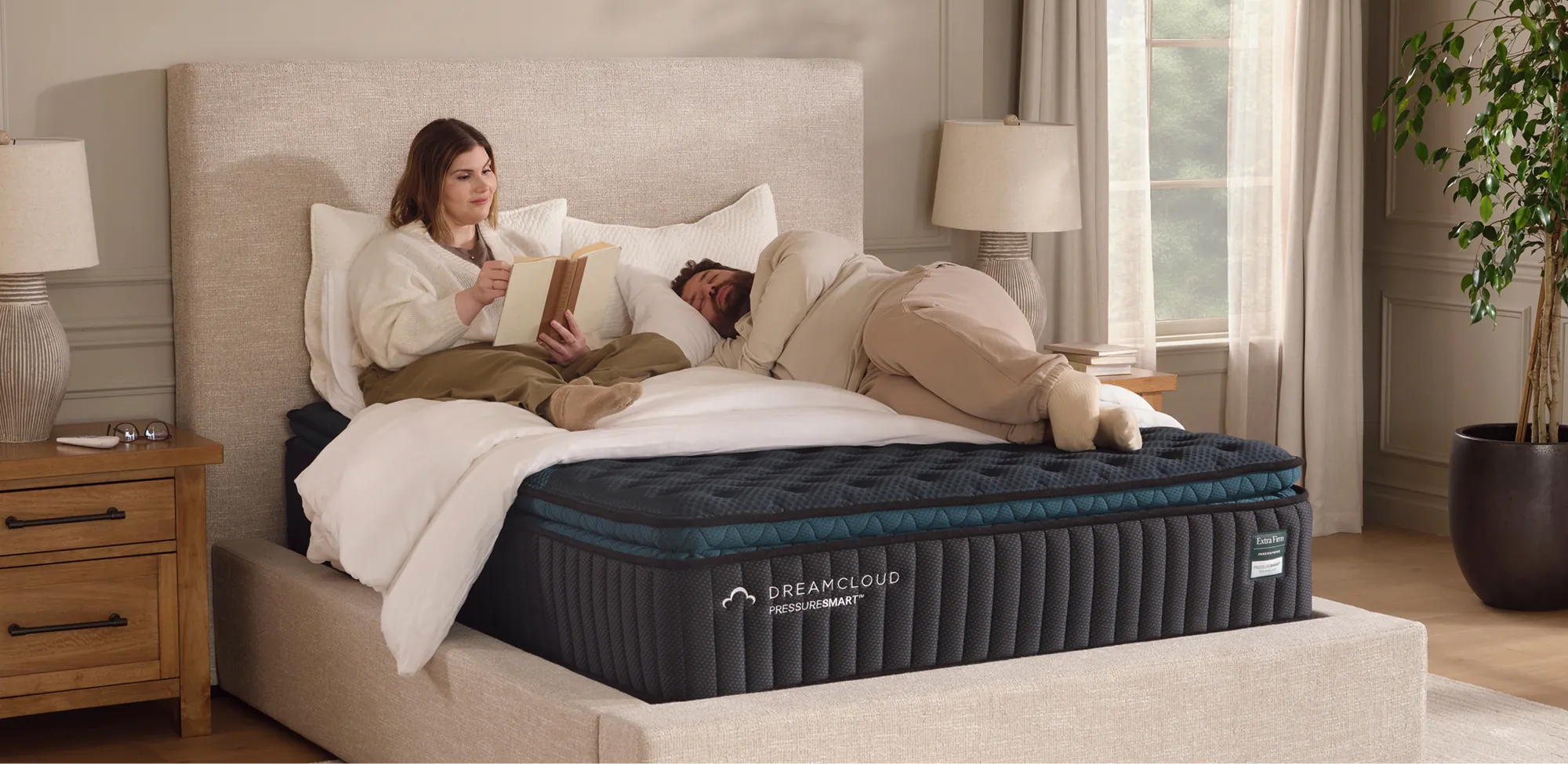
Table of contents
What heavier sleepers actually need from a mattressWhy the coil system matters more than you'd thinkEdge support: why it changes more than you'd expectHeat: an overlooked factor for bigger bodiesHow DreamCloud’s PressureSmart™ line addresses these criteriaChoosing your firmness levelFinding the right fitFrequently asked questions
When it comes to mattress shopping, the recommendation to "just get a medium-firm" gets recycled so often that it barely registers anymore. The problem isn't that it's wrong — it's that it says nothing about the parts of a mattress that actually determine whether a heavier sleeper will still be comfortable two years in.Support compresses. Edges break down. Foam that feels adequate at first can lose its structure well before a mattress should be replaced. The factors that matter for most sleepers matter more when there's more weight involved, and a few factors most buyers don't think about at all become genuinely important.What follows is a guide to those factors: what they are, why they matter, and what to look for so the mattress you choose holds up.dreamcloudsleep/pressure-smart/DCPS_HeavySleeper_Content01.webp
What heavier sleepers actually need from a mattress
Support for a heavier sleeper isn't the same thing as firmness. A firm mattress can still sag prematurely if the coil system underneath isn't dense enough to distribute weight without deformation. And a mattress can feel supportive on day one, but slowly lose its structural integrity under sustained load.The real criteria for heavier sleepers break into four areas:Coil count and density. More individually wrapped coils means finer support mapping and less risk of the mattress sagging through the center under consistent weight. A higher coil count is the difference between a foundation that holds and one that slowly compresses where you sleep most.Foam density. Not all foam is the same. Higher-density foams retain their structure longer, resist compression, and don't bottom out the way lower-density options can. Look for this in the comfort layers especially — that's where most degradation starts.Lumbar reinforcement. The center third of a mattress takes the most pressure from a human body, particularly for back and stomach sleepers. A mattress without deliberate support in that zone tends to develop a body impression right where it's least wanted.Edge support. A mattress that compresses at the edges loses usable sleeping surface over time — and for heavier sleepers, that compression happens faster and tends to continue. Look for a reinforced perimeter coil system that holds its shape under sustained pressure, maintaining the full surface area of the mattress rather than gradually funneling you toward the center.Not sure which mattress fits you best? Find out now.
Why the coil system matters more than you'd think
A hybrid mattress lives or dies by its coil system, and for heavier sleepers, the spec that matters most isn't just whether coils are present — it's how many there are, and how they're arranged.Individually wrapped coils respond independently to pressure, meaning each section of the mattress can flex without transferring that movement to adjacent areas. That independent response also means the coils can be more precisely calibrated: stiffer where the body needs grounding, more responsive where it needs give.Coil count matters because more coils create a finer support grid. A mattress with a low coil count has larger zones of response, which is less precise and more susceptible to uneven wear over time. When you add more weight to the equation, a coarser support grid shows its weaknesses faster.This is one reason coil density tends to be called out specifically in mattresses designed for heavier sleepers. It's not a feature added for optics. It's a structural decision that determines how well the mattress performs — and for how long.Edge support: why it changes more than you'd expect
Edge support isn't only about whether you can sit on the side of the bed without feeling like you're sliding off, though that matters too. It's about usable surface area.A mattress with soft or degraded edges effectively shrinks over time. You migrate toward the center, your partner does the same, and a queen-sized mattress starts sleeping like something smaller. For heavier sleepers, this effect is more pronounced. Edge compression under consistent weight happens faster, and once it starts, it tends to continue.The fix is a coil system with reinforced perimeter support: stronger, denser coils at the edge that maintain their shape under pressure rather than giving way. This keeps the full surface of the mattress usable for longer and makes getting in and out of bed feel like something a mattress should handle without drama.If you've owned a mattress with weak edges, you know the difference isn’t subtle.dreamcloudsleep/pressure-smart/DCPS_HeavySleeper_Content02.webpHeat: an overlooked factor for bigger bodies
There's a practical reason heavier sleepers often sleep warmer: more body mass in contact with the mattress means more compression of comfort layers, which reduces airflow through the foam and can trap heat closer to the surface.This matters because it changes which cooling features actually help. Surface-level cooling — fibers or phase-change materials woven into the cover layer — tends to be more effective than deep-foam cooling for this exact reason. If the cover is where the heat concentrates, the cover is where the solution should be.It's also worth noting that foam running warm tends to degrade faster over time. A sleeping surface that manages heat effectively isn't just a comfort question — it's a longevity question for heavier sleepers in a way it sometimes isn't for everyone else. If you've found that your mattresses seem to soften or lose support sooner than expected, heat retention in the comfort layers may be part of the story.For cooling research that goes deeper into what works at the surface level, our post on what actually makes a mattress cool covers the full picture.How DreamCloud’s PressureSmart™ line addresses these criteria
Our PressureSmart™ line was designed specifically around the support needs of bigger-bodied sleepers, and the construction decisions in each model reflect the criteria above in concrete ways.Every PressureSmart™ mattress includes the PressureSmart™ lumbar support band — a reinforced layer that runs through the center third of the mattress. This is the area that takes the most sustained pressure, and it's where most standard mattresses leave their weakest point. The lumbar band is designed to prevent the center compression that causes premature body impressions and the gradual sense that your mattress isn't holding you the way it once did.The coil system uses PrecisionLift™ individually wrapped coils, with an increased coil count relative to our standard hybrid line. Depending on the model, this means up to 30% more coils than our Classic Hybrid: a denser support grid, more precise weight distribution, and stronger perimeter performance.The CloudCool™ cover weaves cooling fibers directly into the top layer, four times the cooling fiber content of a standard cover, which addresses heat accumulation at the surface where heavier sleepers tend to feel it most.The line comes in four feels:- PressureSmart™ Firm (11.5", 8 layers): A firm innerspring hybrid with the lumbar band and CloudCool™ top. Built for back and stomach sleepers who want grounding, minimal-contour support.
- PressureSmart™ Plush (12.5", 8 layers): The same structural foundation with contouring memory foam comfort layers above the coils. More surface give while the support structure underneath stays the same.
- PressureSmart™ Plush Pillow Top (14.5"): Three foam layers and a quilted pillow top for a softer sleeping experience, still built on the same lumbar-reinforced coil base.
- PressureSmart™ Extra Firm Pillow Top (15", 11 layers): The most supportive model in the line, with extra stabilizing memory foam beneath the lumbar band and the maximum coil count. Designed to deliver four times the back and hip support of our Classic Hybrid.