Skip to Main Content
30-Day Price Match Guarantee
365-Night Home Trial
Forever Warranty™
Free Shipping & Returns
Find in Store

Sleep Health

Published July 14, 2026

11 min

Best pillow for side sleepers: loft & firmness by body type

Finding the right pillow for side sleeping isn't about softness or cooling claims. It's about matching loft to shoulder width and firmness to body weight.

DreamCloud Editorial Team Author
DreamCloud Editorial Team
a side sleeper at rest, shoulder clearly visible, pillow at the correct height relative to the mattress, warm ambient lighting and neutral bedding
Table of contents
Why side sleeping creates a geometry problemHow to find your loft based on shoulder widthHow body weight shapes firmnessFill type and what it actually doesHow your mattress affects the equationThe right pillow fits your bodyFrequently asked questions
Side sleepers have a specific structural problem: when you lie on your side, your pillow has to bridge the gap between your head and the mattress — a gap that's determined entirely by how wide your shoulders are. Get that height wrong, and no amount of memory foam or cooling gel will fix what happens to your neck overnight.Most pillow guides don't address this, sorting instead by fill type and firmness level and leaving the rest to trial and error. This guide works the other way: start with your body, find your loft and firmness range, then narrow from there.
Why side sleeping creates a geometry problem

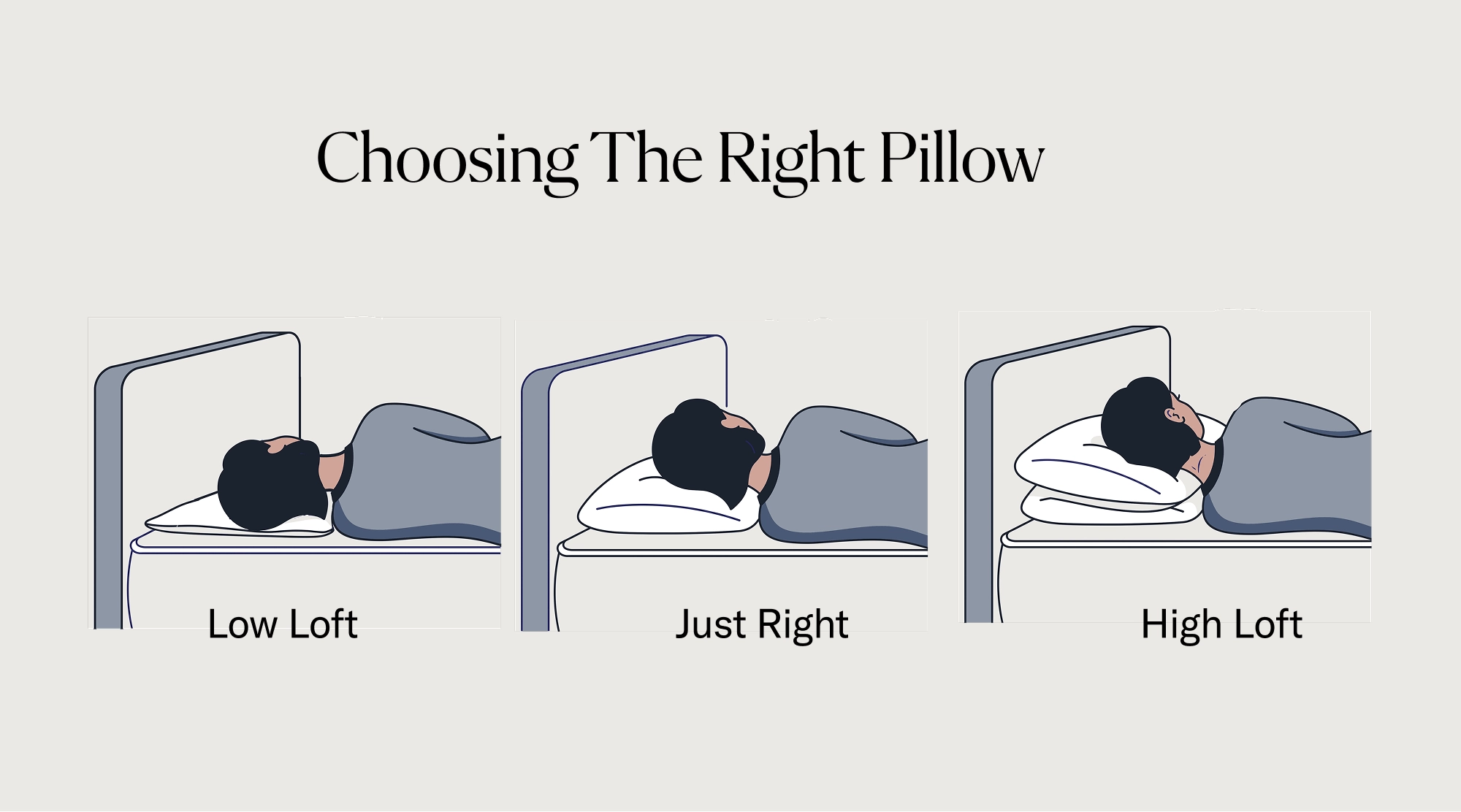
When you sleep on your side, your shoulder acts as a kind of ledge. Your head rests above the mattress by the height of that ledge — roughly the distance from the outer edge of your shoulder to the top of it. For a narrow frame, that gap can be as small as four inches. For a broader one, it can be closer to six or seven.A pillow that doesn't fill that gap leaves your head tilted toward the mattress, compressing the vertebrae on that side. A pillow that overfills it pushes your head in the opposite direction, straining the muscles along the opposite side of your neck. Neither feels like much at 10 p.m, but both tend to make themselves very clear by morning.The reason this matters is that most pillow sizing doesn't account for it. Standard, queen, and king refer to the pillow's footprint — not its height. And "medium firm" describes density in a general sense, not how a specific fill compresses under the sustained weight of a specific head over several hours.https://media.sienasleep.com/image/upload/v1784071952/bestpillow-inline-2.webp

How to find your loft based on shoulder width

Loft is the height of the pillow when it's under your head in a side-lying position. It's not the same as the pillow's stated dimensions — compressed height is what matters, and that varies by fill type and construction.Measure your shoulder width before buying: stand facing a mirror, relax your shoulders, and measure from the outer edge of one shoulder to the other. Then use the following as a starting framework:
Shoulder widthRecommended loft
Narrow (under 14")3–4 inches
Average (14–17")4–5 inches
Broad (17" and above)5–6 inches
One adjustment worth making: if your mattress is on the softer side, you'll sink slightly into the surface when you sleep on your side, which reduces the effective gap between your head and the mattress. In that case, you can typically go one level lower on loft. If you're on a firmer mattress, the gap stays closer to your true shoulder width, and the ranges above apply more directly.

How body weight shapes firmness

Loft gets you to the right height. Firmness is what keeps you there through the night.A pillow that feels supportive when you first lie down can compress significantly over several hours, depending on how dense the fill is and how much your head weighs. Lighter sleepers typically compress fill less than heavier ones, so a pillow that works well for someone at 130 lbs can feel flat and unsupportive for someone at 200. Firmness, in practical terms, is really about how well a pillow resists that gradual compression.
Body weightRecommended firmness
Under 130 lbsSoft to medium
130–200 lbsMedium to medium-firm
Over 200 lbsFirm
These ranges are a starting point. If you run warm, you may want to trade one level of firmness for a more breathable fill. If you're a combination sleeper who spends some time on your back, it's worth going one level lower on firmness to avoid neck strain when your position shifts.https://media.sienasleep.com/image/upload/v1784071952/bestpillow-inline-1.webp
Fill type and what it actually does

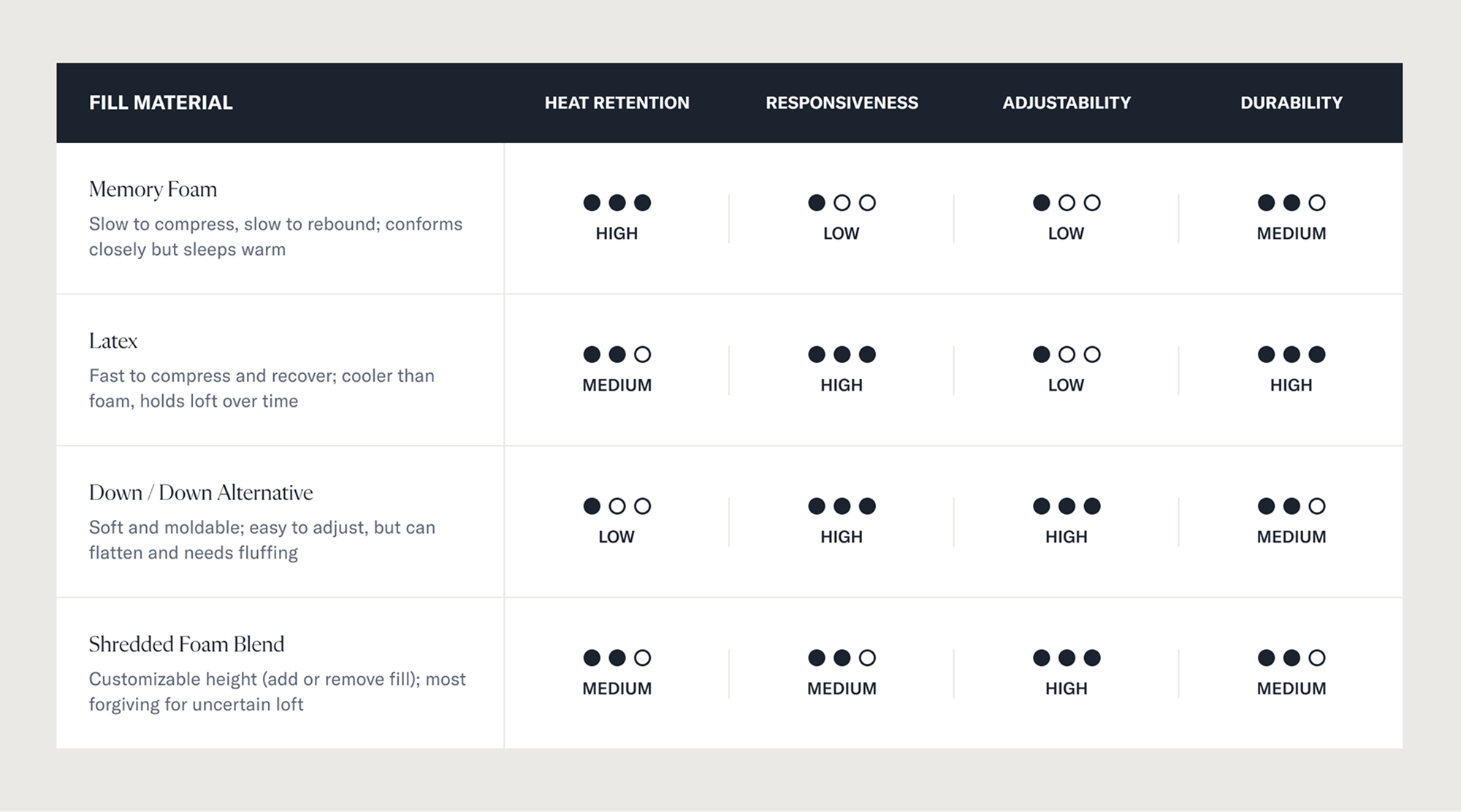
The fill is what determines how a pillow compresses, how it recovers, and how it performs over the course of a night.Memory foam compresses slowly and conforms closely to the shape of your head and neck. It tends to sleep warm and doesn't rebound quickly when you shift positions, which makes it a better fit for side sleepers who stay in one position than for those who move around.Latex is more responsive. It compresses and recovers quickly, sleeps cooler than memory foam, and tends to hold its loft more consistently over time. Heavier sleepers who need sustained support often find latex more reliable than foam across a full night.Down and down alternative are softer, more moldable, and easy to adjust by removing or adding fill. They can flatten over time and need regular fluffing, but they move with you naturally — a useful option if you're between loft brackets and want room to experiment.Shredded foam blends let you customize height more precisely than standard foam by adding or removing fill from the pillow's interior. If you're uncertain about your loft, this is one of the more forgiving options to start with.

Not sure which mattress fits you best? Find out now.

How your mattress affects the equation

Your mattress and your pillow are connected decisions. The firmness of your sleep surface affects how much you sink when you lie on your side, which changes the effective loft you need.On a firmer mattress, your shoulder stays higher off the surface, keeping the gap between your head and the mattress closer to your true shoulder width. On a softer mattress, your shoulder sinks into the surface, reducing that gap — so you can typically use a lower loft pillow than the shoulder-width chart might suggest.This is worth keeping in mind if you're shopping for a new mattress alongside a new pillow. Our guide to the best mattress for side sleepers covers how surface firmness maps to side-sleeping support — and how the two decisions interact when you're making them at the same time.For a pillow designed with side sleepers in mind, the DreamCloud Tri-Comfort Cooling Pillow uses a three-zone construction that keeps the center firmer where your head rests and softer around the edges, with a cooling cover that keeps airflow moving through the night. It's available in two loft options, which makes matching your shoulder width more straightforward than standard one-size pillows allow.

The right pillow fits your body

Shoulder width and body weight are the two most useful inputs when choosing a pillow for side sleeping — and they're also the two that most people skip. Picking a pillow by feel in a store, or by review averages online, bypasses the step that determines whether it will actually work for your specific geometry across a full night.Measure your shoulder width, note your weight, and use those two data points to narrow to a loft and firmness range. Then choose the fill type that fits how you sleep — whether it’s one consistent position or a combination throughout the night. Getting those variables right is usually the change that makes mornings noticeably better.

Frequently asked questions

What loft is best for side sleepers? Most side sleepers do well with a loft between 4 and 6 inches, though the right height depends on shoulder width. Narrower shoulders often need 3–4 inches; broader shoulders can need 5–6 or more to keep the spine in a neutral position through the night.Is a firm or soft pillow better for side sleeping? Medium to medium-firm tends to work well for most side sleepers. Heavier sleepers often benefit from a firmer pillow that resists compression over several hours; lighter sleepers can often go softer without sacrificing support.Can the wrong pillow cause neck pain? Yes — a pillow that's too low lets the head tilt toward the mattress and can put sustained pressure on the cervical spine. A pillow that's too high pushes the head away from neutral in the other direction. Both can result in morning stiffness or tension, particularly if you tend to stay in one position through the night.How do I know if my pillow loft is right? The clearest indicator is how your neck and shoulders feel in the morning. Waking without tension and feeling like your neck was in a neutral position is a good sign. Consistent stiffness on one side, or tension at the base of the skull, is usually worth adjusting loft before changing anything else.Should side sleepers use one pillow or two? Most side sleepers do better with a single pillow sized correctly for their shoulder width. Stacking two can create uncontrolled height that shifts through the night and is harder to troubleshoot than simply finding the right loft in a single pillow.