Buying Guides
Published June 1, 2026
11 minKids Beds: Twin, Bunk & Storage Buying Guide
The right kids bed does more than just fill a room — it fits your child, their space, and their everyday lives.

Table of contents
How Kids' Sleep Needs Change With AgeKids Bed Types and What Each One Does BestSizing: What the Numbers Actually MeanSafety Standards Worth UnderstandingWhat to Look For in a FrameRoom Layout and Practical Sizing TipsA Bed Worth Getting RightFrequently Asked Questions
Choosing a bed for a child is one of the few furniture decisions that asks you to think several years ahead, all at once. A size that works well at six can feel cramped by ten, the bunk bed they’re asking for needs to be genuinely safe before it becomes an option. This guide covers the main bed types, what sizing means for different ages, safety standards worth understanding, and how to make a choice for your family that holds up.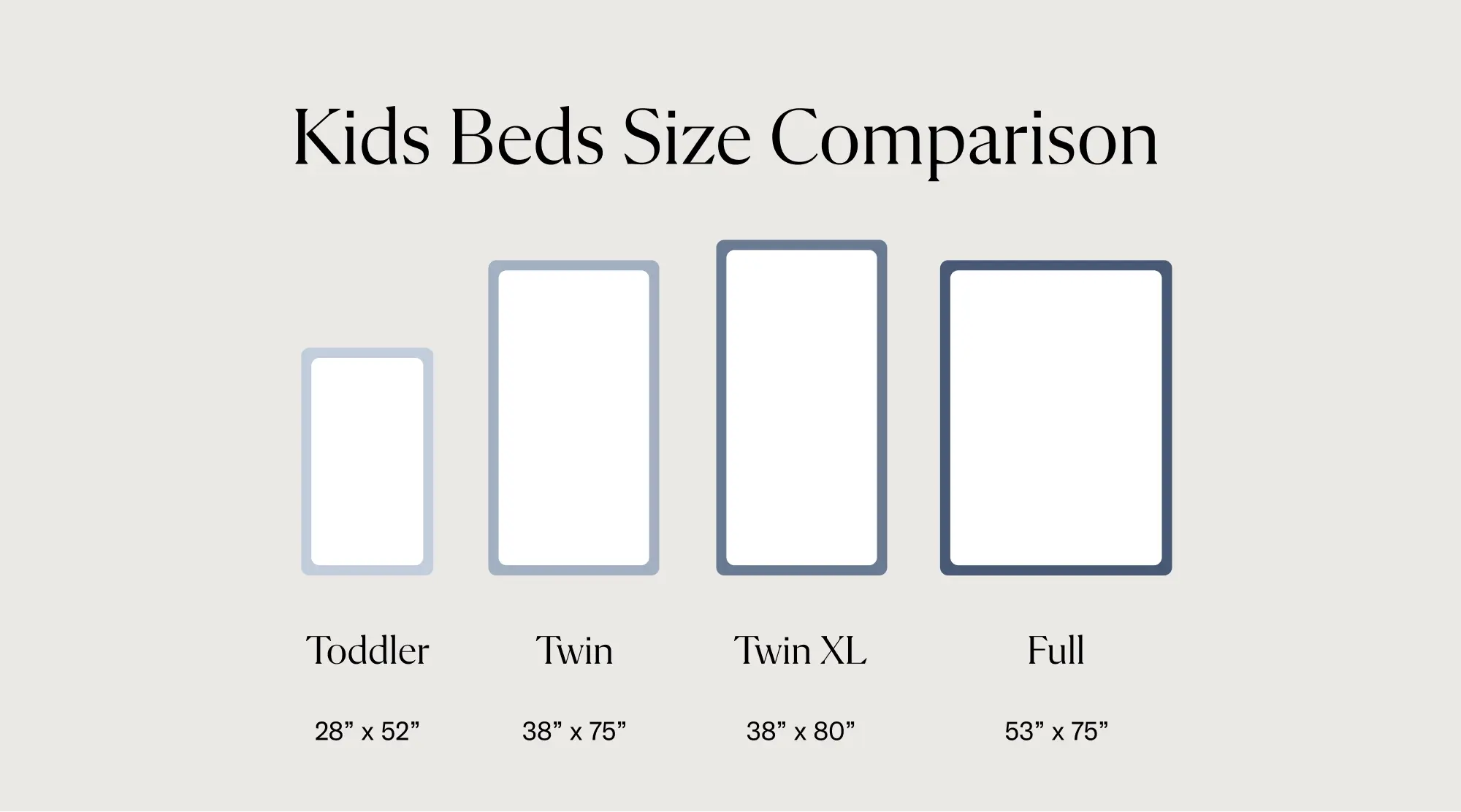
As a practical note on room planning: three sides of a bed generally need at least 24 inches of clear space for comfortable movement, with more clearance where a desk or dresser will also be present. For bunk configurations, ceiling height is the constraint that matters most — a room with 8-foot ceilings typically allows enough clearance for most standard bunk frames.
How Kids' Sleep Needs Change With Age
Understandably, your child has different needs from their bedroom furniture as they age. A toddler transitioning out of a crib has different priorities than a school-age child sharing a room with a sibling — and both are meaningfully different from a pre-teen who needs a desk, storage, and personal space built into the same small room.The most common progression starts with a toddler bed or twin for the early years, roughly ages 2 through 7, then moves to a standard twin or twin XL as your child grows longer, typically around ages 7 to 12, and eventually to a full for older children who need more sleeping space. Some families skip the toddler bed entirely and go straight to a twin with guardrails — which is a reasonable call, since a twin can serve a child from around age three well into their teens.When taking your child’s bedroom into account, the same underlying principle applies across all of it: buy for where they're going, not just where they are.Kids Bed Types and What Each One Does Best
Understanding the category is half the decision. Each bed type has a different set of trade-offs when it comes to space, flexibility, and adaptability.Twin Beds
The twin is the standard starting point: compact enough for smaller rooms, compatible with the widest range of frames and bedding, and easy to replace or refresh when tastes change. A standard twin at 38 by 75 inches works in rooms as small as 7 by 10 feet without feeling cramped, and most twin frames can easily be updated with a headboard swap as children get older. For single-child bedrooms, a well-chosen twin with a good mattress is often the only bed they'll need until high school.Bunk Beds
Bunk beds solve one problem very effectively: two sleeping surfaces that take up the floor space of one. For shared rooms, they're often the most practical option available. Most standard bunks use a twin-over-twin configuration, though twin-over-full designs are increasingly common and more flexible — the lower full berth can accommodate a taller child, a frequent co-sleeper, or eventually serve a teenager who has outgrown a twin.There are trade-offs to bunk beds that are worth understanding before purchasing. They require a clearance of at least 33 to 36 inches above the top mattress surface for comfortable sitting, which rules them out in rooms with lower ceilings. Weight limits on the top bunk are typically stated by the manufacturer and should be checked against not just your child’s current weight, but also where they’ll likely be in two or three years.Loft Beds
A loft bed raises a single sleeping surface to allow storage, a desk, or a play area underneath — it’s essentially a bunk bed where the lower bunk is replaced with usable floor space. For a child who needs a dedicated workspace in a smaller bedroom, a loft can effectively double the functional area of the room. They tend to work best for children over 6, once climbing and spatial awareness are more developed.Storage Beds
Storage beds incorporate drawers or a lift-up platform directly into the frame, which makes them well-suited for rooms without much closet space. The integrated storage replaces the need for a separate dresser, keeping the floor clear and the room feeling more open. The trade-off is that they tend to be heavier and harder to move, and so less ideal for families who rearrange frequently.Daybeds and Trundle Beds
A daybed functions as seating by day and a full sleeping surface by night, making it a natural fit for a child's room that doubles as a playroom or occasional guest space. A trundle pulls a second mattress from beneath a standard-height frame, which handles sleepovers without permanently occupying more floor space. Both formats tend to be better suited for children who primarily use their rooms solo, since neither offers the dedicated sleeping configuration of a dedicated frame.Sizing: What the Numbers Actually Mean
Sizing decisions come down to your child's age and height, how long the bed needs to serve them, and the actual dimensions of the room.| Bed Size | Dimensions | Works Best For |
| Toddler / Crib | 27 × 52 in | Ages 1–3 transitioning from a crib |
| Twin | 38 × 75 in | Ages 3–12; fits rooms from 7 × 10 ft |
| Twin XL | 38 × 80 in | Ages 10+; taller children who need the length |
| Full | 54 × 75 in | Ages 10+; single sleepers who want more width |
Safety Standards Worth Understanding
For any elevated sleeping surface, a few specific things tend to separate a well-built frame from one that only looks the part.Guardrails should extend at least 5 inches above the mattress surface, covering all open sides on a top bunk and the wall-facing side on lower bunks and lofts. The gap between guardrail slats should be no wider than 3.5 inches — gaps wider than that create an entrapment risk that manufacturers meeting current safety standards will have already accounted for. ASTM F1427 is the U.S. safety standard for bunk beds specifically, covering structural requirements, guardrail dimensions, and ladder specifications; and products that meet this standard will state it in their documentation.Frame construction matters here too — not just for safety but for longevity. Bolted metal connections and solid wood joinery hold up better under repeated movement and climbing than cam-lock fasteners or MDF construction, particularly on beds that will see years of active, physical use.